
How fast is your body ageing? And what actually determines it.

Most people focus on fitness, diet, or supplements. Very few understand what actually drives biological age.
Key takeaways
- Biological age reflects how your body is actually ageing
- Sleep, recovery, and metabolic health are the biggest drivers
- Most people optimise the wrong things
- Without tracking signals, you are guessing
- The goal is not information, but correct decisions
Most people think they’re healthy
Not exceptionally fit, not obsessively disciplined, just… doing enough. They train a few times a week when they can. They try to make better food choices. They get what they believe is a reasonable amount of sleep, most nights.
There’s a quiet confidence in that rhythm. No obvious warning signs, no major issues, nothing that suggests anything is wrong. If anything, it feels like progress, or at the very least, maintenance.
And that’s exactly where the illusion begins.
You can be doing everything right…
and still be ageing faster than you think.
Because health, as most people understand it, is measured through effort. It’s defined by what you do, how often you train, how clean you eat, how consistent you are. But your body doesn’t experience effort in the same way you do. It doesn’t reward intention. It responds to internal conditions.
What matters is not what you did today, but how your biology reacted to it. And those reactions are happening constantly, beneath the surface, whether you’re aware of them or not.
It’s entirely possible to be doing what looks like the “right” things, exercising regularly, eating relatively well, staying active, while your body is quietly moving in the opposite direction. Recovery can be declining. Stress can be accumulating. Metabolic function can be shifting. Small changes, individually invisible, begin to compound. Nothing dramatic. Nothing urgent. Just a gradual drift.
The problem is that most of these changes don’t feel like anything at first. There’s no clear signal that something is off. No moment where your body stops and tells you that your internal state is changing. Instead, it adapts. It compensates. It keeps you functioning, just at a slightly lower level than before. So you keep going.
You assume that because nothing feels broken, everything must be working. But what you feel and what your biology is doing are not the same thing.
You might feel fine. You might feel functional, even productive. But those feelings don’t tell you how well your body is recovering, how stable your energy systems are, or how much strain your internal systems are under. They don’t tell you whether your body is maintaining itself, or slowly degrading.
And that gap, between perception and reality, is where most people get it wrong.
It’s not that they’re neglecting their health. It’s that they’re operating without feedback. Without a clear understanding of how their body is responding, every decision becomes a form of educated guesswork. They adjust things based on what they’ve heard, what’s trending, or what has worked for someone else, without ever knowing if it’s actually working for them. Over time, that uncertainty compounds.
Years of “doing the right things” can still lead to outcomes that don’t match the effort, not because the effort wasn’t there, but because it wasn’t aligned with what the body actually needed.
And by the time the signals become obvious, the shift has already been happening for longer than most people realise.
Ageing isn’t a slow decline.
Research shows it accelerates in distinct waves, particularly around ages 40 and 60.

What is biological age?
Biological age measures how your body is functioning relative to your chronological age.
It reflects the condition of your systems, including recovery, metabolism, inflammation, and stress.
Unlike chronological age, biological age can improve or decline based on your behaviour and internal health signals.
Your blood knows how fast you’re ageing.
Hundreds of circulating proteins shift predictably with age, revealing your biological timeline.
Most people are ageing faster than they think.
Why most health advice fails
Health today is fragmented.
Not in the sense that there isn’t enough information, but in the way that information is delivered. You track your sleep in one app, check your blood work once or twice a year, follow diet advice from social media, and take supplements based on what you’ve heard works. Each of these gives you a piece of the puzzle. Individually, they feel useful. Collectively, they create the illusion of understanding.
But they never quite connect. And that’s the real problem. It isn’t a lack of data. It’s a lack of coherence.
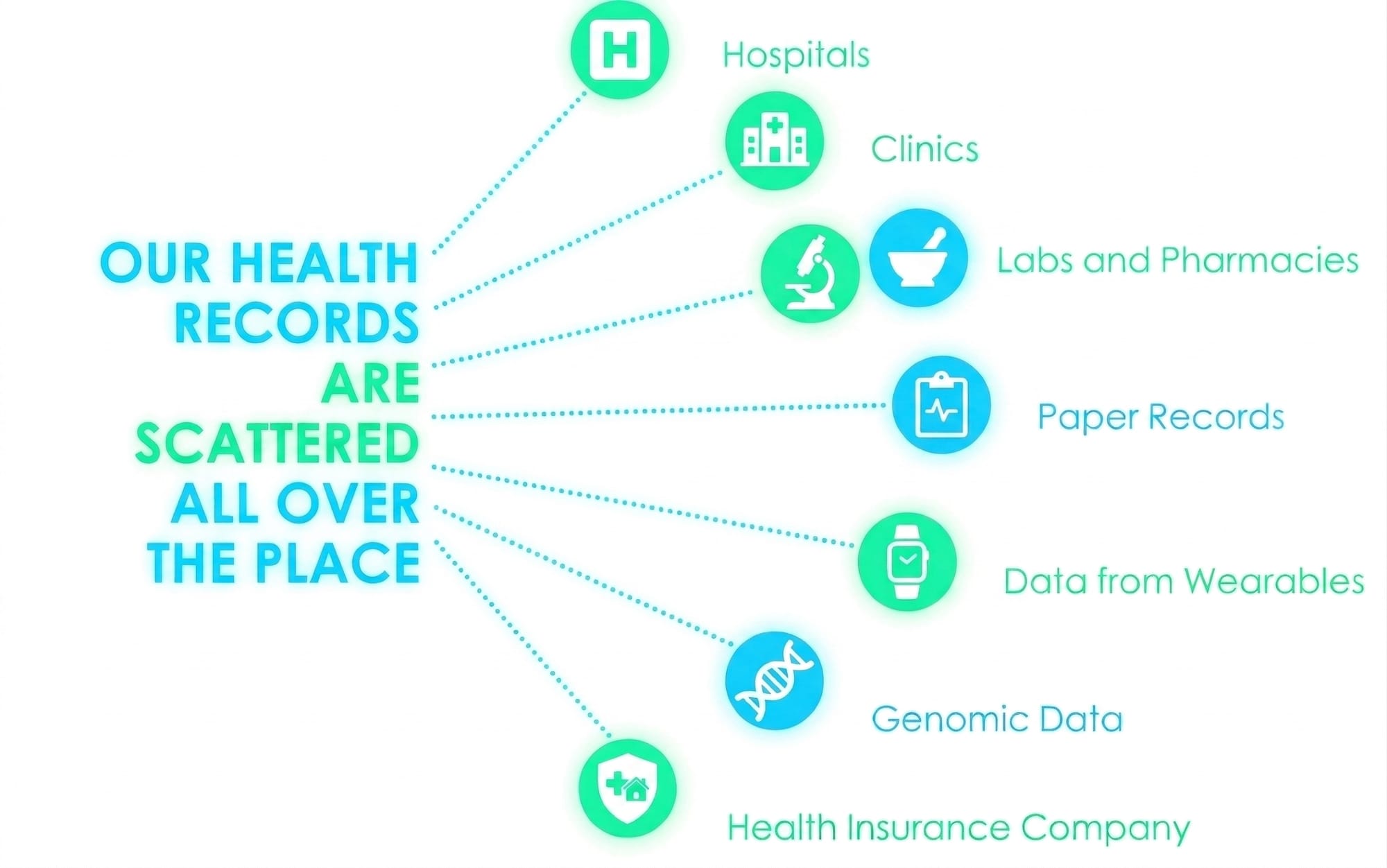
Most health advice treats the body as a collection of separate systems, each to be optimised on its own. Sleep is improved independently. Nutrition is adjusted in isolation. Training is planned without context. Supplements are layered on top as if they operate in a vacuum. On paper, it all makes sense. In practice, it rarely works the way people expect. Because your body doesn’t function in isolated parts. It operates as a system.
Sleep influences recovery. Recovery determines energy. Energy shapes metabolic function. Metabolism affects inflammation. And inflammation, over time, becomes one of the strongest drivers of how quickly your body ages. These aren’t separate processes, they are constantly interacting, adjusting, compensating.
You don’t age as one system. Your brain, heart, metabolism, and immune system can all age at completely different rates.
When one part of the system shifts, everything else moves with it.
This is where most people get stuck, even when they’re trying to do the right thing. They focus on improving one area without understanding what’s happening across the rest of the system. They sleep slightly better, but ignore underlying stress. They train harder, even as recovery declines. They introduce supplements without knowing whether there’s a deficiency, an overlap, or no real need at all.
The result isn’t failure, it’s inconsistency.
Some days feel better. Others don’t. Progress becomes difficult to measure, and even harder to sustain. Not because the effort isn’t there, but because it isn’t aligned with what the body actually requires. Timing makes this even more complicated.
Most people only check their biology occasionally. A blood test once a year. A wearable score they glance at in the morning. A general feeling of “I’m a bit tired” or “I feel okay today.” But ageing doesn’t operate on that timeline. It isn’t something that updates once a year or reveals itself in obvious, dramatic shifts.
It’s happening continuously.
Small changes accumulate quietly, day after day. Recovery trends downward over weeks. Stress builds gradually. Metabolic stability drifts. None of it feels urgent in isolation, but over time it compounds into something meaningful.
Without continuous feedback, you’re always reacting after the fact.
Ageing doesn’t start when you feel it. Biological decline often begins decades before symptoms appear.
By the time a problem becomes visible enough to notice, your biology has already been shifting for weeks, sometimes months. What feels like a sudden change is often the result of a slow, unobserved trend. And that creates a false sense of control.
You believe you’re improving your health because you’re doing the right things on paper. You’re consistent. You’re disciplined. You’re making better choices than you were before. But without a clear view of how your body is responding, those choices are still based on assumption.
Underneath it all, your internal signals may be telling a very different story.
The result
You might:
- feel generally fine
- follow good habits
- believe you’re on the right path
But your biological age could still be increasing faster than it should.
Chronic inflammation is one of the core drivers of ageing.
It silently accelerates damage across nearly every system in the body.
Why this matters
Because the goal isn’t just to “feel healthy”.
The goal is to:
- slow ageing
- improve recovery
- increase resilience
- extend long-term health-span
And that only happens when your decisions match your biology.
Your rate of ageing is not fixed.
Sleep, nutrition, stress, and movement can measurably speed it up or slow it down.
Without a system, more health data doesn’t create clarity. It creates noise.
Rewind's perspective
Most health systems give you data and leave you to interpret it. Rewind is built to connect everything.
Instead of isolated insights, it treats your body as a system:
- signals are combined
- patterns are detected
- decisions are made
- actions are adjusted
So you’re no longer guessing. You’re responding to what your body actually needs.
Most platforms stop at information. They collect data. They surface insights. They suggest actions and then they stop. That leaves one critical gap: The user still has to decide what to do, when to do it, and whether it’s working.
Rewind was built to remove that gap. Instead of separating data, insight, and action, it connects them into a single system that:
- detects changes in your biology
- decides the next step
- updates your protocol
- and ensures execution happens
There is no interpretation layer. There is no guesswork.
There is only alignment between what your body needs and what you do next. At some point, most people notice something feels off.
Energy isn’t as consistent, recovery takes longer, sleep doesn’t feel as restorative.
Nothing dramatic.
Just a subtle shift. And because it’s subtle, it’s easy to ignore.
In a system like Rewind, these signals aren’t just tracked, they’re used to continuously update what you should do next.
Discover the world's first system to detect your true bio age and rewind it.
Your body is a system, not a set of metrics
Sleep affects recovery, recovery affects energy, energy affects metabolism, metabolism affects ageing. These systems don’t operate independently. They interact constantly.
When one breaks down, others follow.
The biggest mistake people make
The biggest mistake isn’t doing too little.
It’s doing the wrong thing for your biology.
Training harder when recovery is low.
Taking supplements you don’t need.
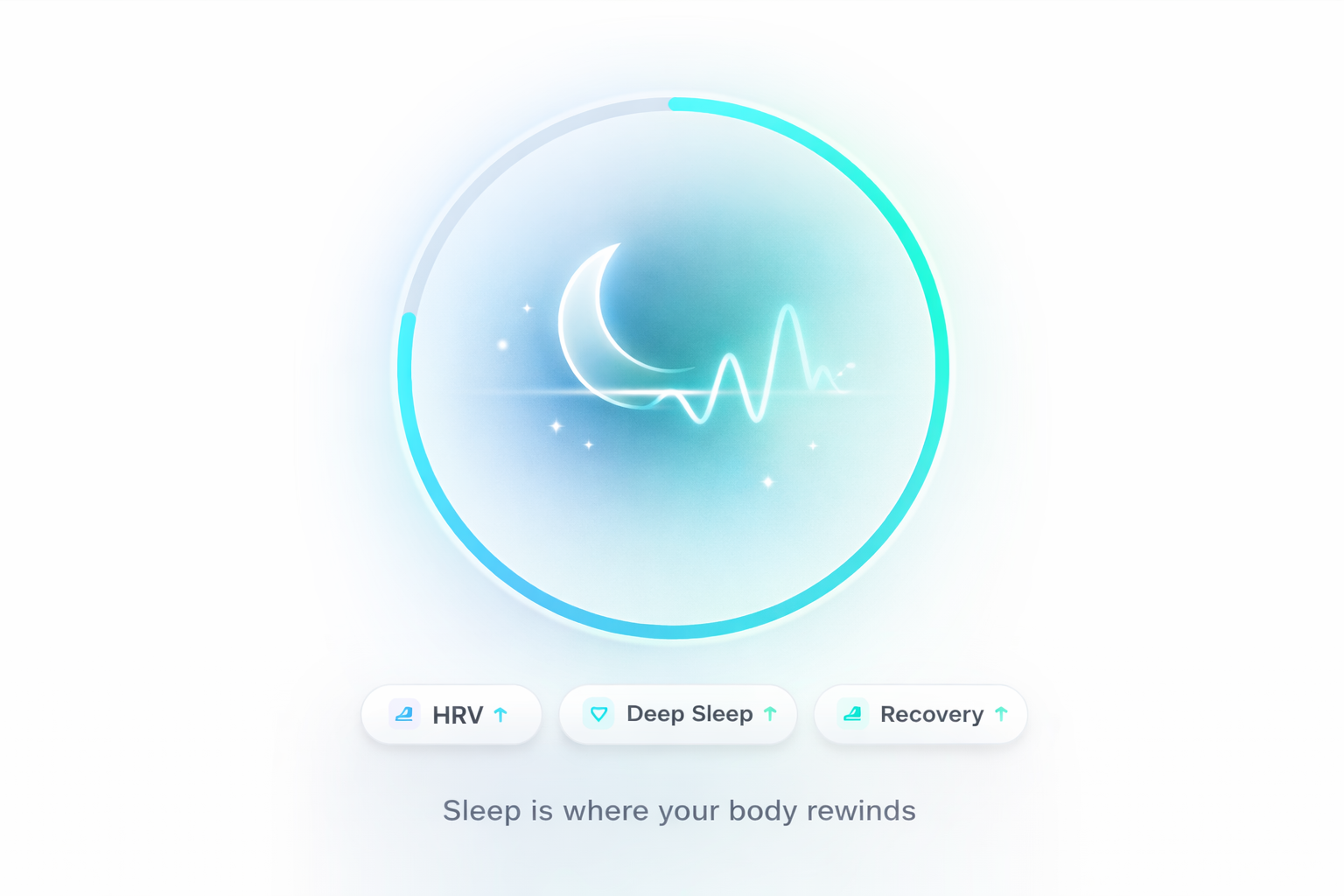
Ignoring signals like low HRV or poor sleep.
Without context, optimisation becomes noise.
The signals that actually matter
If you want to understand how your body is ageing, focus on signals:
- HRV (recovery and stress)
- Sleep quality (not just duration)
- Resting heart rate
- Glucose and metabolic stability
- Inflammation markers
These signals tell you what your body is actually doing, not what you think it’s doing.
What to do next
- Measure Your Biology — understand your current biological state
- Measure Vitals via Wearables — look at how your signals interact
- Adjust — change behaviour based on your state
- Track — see what actually moves the needle
Where Rewind changes the equation
Most platforms stop at data. They show you metrics and leave you to figure it out.
Rewind takes a different approach. It connects your signals into a system that:
- detects what’s happening
- decides what to do
- updates your protocol
- helps you execute
There is no guesswork. Only aligned action.
Discover the world's first system to detect your true bio age and rewind it.
Start with your biology
Your genes don’t determine your age, your biology does.
While your DNA sets the blueprint, epigenetic changes, chemical signals that turn genes on or off, control how that blueprint is expressed. These changes are influenced by sleep, stress, nutrition, and environment, and they directly impact how fast your body actually ages.
Biological age is not fixed, it’s responsive.
Unlike chronological age, it can move in both directions. Research shows that targeted interventions, including sleep optimisation, metabolic health, exercise, and nutrition, can measurably slow, stabilise, and in some cases even reverse markers of biological ageing.
Most people never measure how their body is actually ageing.
Check your biological age and see what your body really needs.
Frequently asked questions
What is biological age?
Biological age measures how your body is functioning based on internal health signals like recovery, metabolism, and stress.
Can biological age be reversed?
Yes. Biological age can improve depending on sleep, recovery, metabolic health, and behaviour.
What affects biological age the most?
Sleep, stress, metabolic health, and inflammation are the biggest drivers.
Why do I feel healthy but still age faster?
Because subjective feeling doesn’t always match internal biological signals like HRV, inflammation, or glucose control.
Rewind Insight
Your body is either ageing or reversing.
The difference is whether your decisions match your biology.
Start with your biology
Most people never measure how their body is actually ageing.
Not because they don’t care, but because they’ve never had a system that makes it clear. If your biology is already shifting, you won’t feel it straight away.
But the earlier you see it, the more control you have.
Health isn’t about what you do.
It’s about how your body responds.
Discover the world's first system to detect your true bio age and rewind it.
Member discussion