
How Much Sleep Do You Really Need? It Depends on Your Sex.
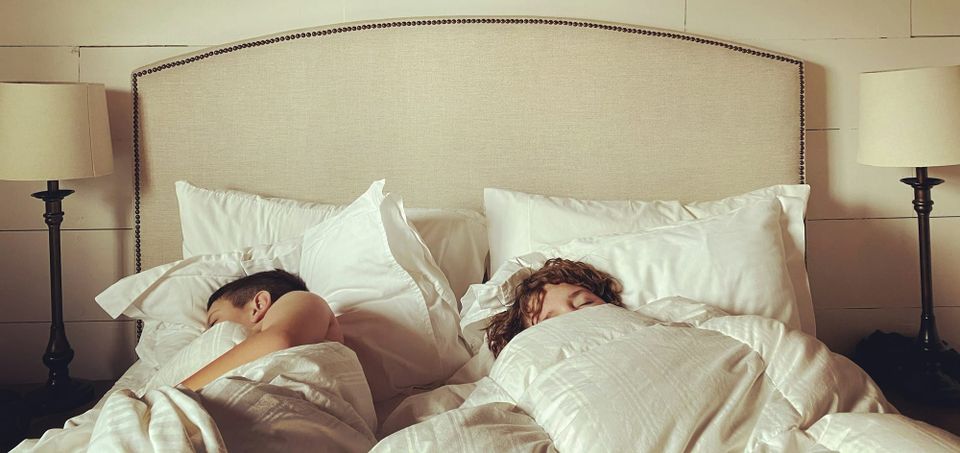
The 8 hour rule is a population average. Your biology is not average.
A study of 439,933 adults in the UK Biobank found that 7 hours of sleep was associated with the lowest risk of cognitive decline and mental health burden, but the optimal window shifted by sex: women who slept 7 to 7.5 hours outperformed those at 7, while men showed the sharpest cognitive performance at 7 hours flat (Li et al., 2022). The "8 hours for everyone" guideline obscures the fact that sleep needs are shaped by hormonal cycles, brain structure, and metabolic demand, all of which differ between men and women.
Horne and colleagues at Loughborough University demonstrated that women use more of their brain's prefrontal cortex during the day through multitasking and complex cognitive processing, and that this increased neural workload generates a correspondingly greater need for restorative sleep (Horne, 2016). The implication is not that women are "worse" sleepers. It is that their brains require more recovery time. When they do not get it, the cognitive and metabolic penalties are steeper.
The National Sleep Foundation's updated guidelines recommend 7 to 9 hours for adults 26 to 64, a range so wide it is nearly useless for individual optimization (Hirshkowitz et al., 2015). Your actual need depends on your sex, your training load, your hormonal status, and, increasingly, what your sleep architecture looks like on a wearable. The number on the clock matters less than the structure underneath it.
Key Takeaways
- Women require 20 to 30 minutes more sleep than men on average, driven by greater prefrontal cortex utilization (Horne, 2016).
- 7 hours is the cognitive sweet spot for men; 7 to 7.5 hours for women (Li et al., 2022).
- Sleep deprivation increases inflammatory markers (hsCRP, IL-6) more sharply in women than in men.
- Optimal sleep is defined by architecture (deep sleep, REM proportions), not just duration.
What optimal sleep duration actually is
Most people think the answer is a single number. Optimal sleep duration is defined as the amount of total sleep time that maximizes next-day cognitive performance, minimizes inflammatory biomarkers, and preserves long-term cardiometabolic health. It is not 8 hours. It is a range that varies by sex, age, fitness level, and hormonal phase. The critical insight is that duration alone is insufficient. Two people sleeping 7.5 hours can have profoundly different outcomes if one gets 90 minutes of deep sleep and the other gets 45. Duration sets the frame. Architecture fills it.
The problem with one-size-fits-all sleep advice
The CDC, the American Academy of Sleep Medicine, and most public health bodies issue a blanket recommendation: 7 to 9 hours for adults. That range spans a 2 hour gap, which is a 29 percent difference at the low end. No other health recommendation tolerates that kind of variance and calls it guidance.
The bigger problem is sex-blind averaging. Mong and Cusmano published a comprehensive review in Neuroscience and Biobehavioral Reviews showing that sex differences in sleep architecture, circadian timing, and sleep disorder prevalence are robust and clinically significant (Mong & Cusmano, 2016). Women have more slow-wave sleep than men but are more vulnerable to insomnia. Men have more stage N1 (light sleep) and are more vulnerable to obstructive sleep apnea. Hormonal fluctuations across the menstrual cycle, pregnancy, and perimenopause alter sleep structure in ways that a single recommended range cannot capture.
When you tell a perimenopausal woman and a 35 year old male athlete to both "get 7 to 9 hours," you are giving advice that accounts for neither of their biologies.
What the evidence actually shows
Li and colleagues analyzed cognitive data from nearly 440,000 UK Biobank participants and found a nonlinear relationship between sleep duration and cognitive function, with the nadir of impairment at 7 hours. The association was stronger in women, where both short sleep (under 6 hours) and long sleep (over 8 hours) carried greater cognitive penalties than in men (Li et al., 2022).
Separately, Irwin and colleagues demonstrated that partial sleep deprivation (sleeping 6 hours or fewer) activates the nuclear factor kappa B inflammatory pathway more aggressively in women, producing higher levels of IL-6 and TNF-alpha the following day (Irwin et al., 2008). Sleep loss is more inflammatory for women, and inflammation is a driver of accelerated biological aging.
The Finnish Twin Cohort, following over 21,000 adults for more than 20 years, found that sleeping fewer than 7 hours or more than 8 hours was associated with increased mortality in both sexes, but the effect was more pronounced in women for short sleep (Hublin et al., 2007).

The mistake most people make
The most common error is optimizing for time in bed rather than sleep architecture. If you go to bed at 10 PM and wake at 6 AM but spend 45 minutes awake in the middle of the night, your total sleep time is 7 hours and 15 minutes, not 8. Your wearable may show 8 hours of "time in bed" and you believe you are sleeping enough. You are not. Sleep efficiency, the ratio of time asleep to time in bed, should be above 85 percent. Below that, you are accumulating fragmented sleep that underdelivers on deep sleep and REM regardless of how long you lie there.
A second error specific to women is ignoring how the menstrual cycle shifts sleep need. Progesterone, which rises in the luteal phase, is mildly sedating and increases core body temperature, both of which alter sleep architecture. Many women need 30 to 60 minutes of additional sleep in the luteal phase. Ignoring this window creates a recurring monthly sleep debt.
Signals to check this week
Track these alongside total sleep duration to understand your actual sleep quality.
| Signal | Lab "Normal" | Optimal Target |
|---|---|---|
| Total sleep time | 7 to 9 hours | 7 to 7.5 hours (men), 7.5 to 8 hours (women) |
| Sleep efficiency | > 75% | > 85% |
| Deep sleep (N3) | 10 to 20% of total | > 15% of total (60 to 90 min) |
| REM sleep | 20 to 25% of total | > 20% of total |
| Sleep onset latency | < 30 min | 10 to 20 min |
If your deep sleep is consistently below 45 minutes despite adequate duration, the architecture is the problem, not the clock.
What to do
-
Set your target by sex. Men: aim for 7 to 7.5 hours of actual sleep time. Women: aim for 7.5 to 8 hours, adding 30 minutes during the luteal phase if you track your cycle.
-
Measure sleep efficiency, not time in bed. Use a wearable that reports sleep efficiency. If efficiency is below 85 percent, address the causes of fragmentation: caffeine after noon, alcohol, light exposure, or temperature.
-
Prioritize deep sleep over total hours. Resistance training, cold exposure before bed (a warm shower followed by a cool room), and limiting alcohol to zero on weeknights all increase deep sleep percentage.
-
Anchor your wake time. A consistent wake time is more powerful than a consistent bedtime for circadian alignment. Fix the wake time within a 30 minute window 7 days per week.
-
Track inflammatory markers alongside sleep data. If hsCRP is above 1.0 mg/L and you are sleeping fewer than 7 hours, the sleep deficit is a likely contributor. Improving sleep duration often lowers hsCRP within 4 to 6 weeks.
This is the kind of pattern Rewind connects. We pair your wearable sleep data with inflammatory biomarkers and hormone panels so you can see whether your sleep architecture is actually regenerating your biology or just filling hours. When deep sleep drops below your personal baseline, the system flags it alongside the metabolic markers that shift in response.
Find your actual sleep number
The generic recommendation will not tell you whether your sleep is working. Rewind integrates sleep architecture with biomarker data to show you what your body actually needs. Start at https://rewind.life.
FAQ
Do women really need more sleep than men?
Yes. Research consistently shows women need 20 to 30 minutes more sleep, driven by greater prefrontal cortex workload during waking hours and higher vulnerability to inflammatory consequences of sleep deprivation.
Is 6 hours of sleep enough if I feel fine?
Subjective adaptation to sleep restriction is well documented. You stop feeling tired, but cognitive testing, inflammatory markers, and glucose metabolism continue to deteriorate. Feeling fine is not the same as performing optimally.
Does exercise change how much sleep you need?
Heavy training increases the need for deep sleep. Endurance athletes and those doing intense resistance training may need 8 to 9 hours. Monitor deep sleep percentage rather than adding arbitrary hours.
How does menopause affect sleep needs?
Declining estrogen and progesterone increase sleep fragmentation and reduce deep sleep. Many women in perimenopause need to extend their sleep window by 30 to 60 minutes and address hormonal contributors directly with their clinician.
Can naps replace lost nighttime sleep?
Short naps (20 to 30 minutes) improve alertness but do not generate the deep sleep or consolidated REM that nighttime sleep provides. They supplement. They do not substitute.
Sleep is not a single number. It is an architecture shaped by your sex, your hormones, and your training load. At Rewind, we read the structure, not just the clock, because two people sleeping 7.5 hours can be living in different biological realities.
Your sleep number is personal. Your data should reflect that.
Population averages obscure the differences that matter most: the hormonal shifts that change sleep need monthly, the training loads that demand more deep sleep, the inflammatory signals that reveal whether your sleep is restoring you or merely passing time. Rewind tracks sleep architecture alongside the biomarkers that respond to it, giving you a sleep profile that a single number cannot provide. A wearable tells you how long you slept. Your bloodwork tells you whether it was enough. Together, they define your actual need. Explore how at https://rewind.life.
Reference List
Hirshkowitz, M., Whiton, K., Albert, S. M., Alessi, C., Bruni, O., DonCarlos, L., Hazen, N., Herman, J., Katz, E. S., Kheirandish-Gozal, L., Neubauer, D. N., O’Donnell, A. E., Ohayon, M., Peever, J., Rawding, R., Sachdeva, R. C., Setters, B., Vitiello, M. V., Ware, J. C., & Adams Hillard, P. J. (2015).
National Sleep Foundation’s sleep time duration recommendations: Methodology and results summary. Sleep Health, 1(1), 40–43.
Horne, J. (2016).
Why women need more sleep than men. Loughborough University Sleep Research Centre.
Hublin, C., Partinen, M., Koskenvuo, M., & Kaprio, J. (2007).
Sleep and mortality: A population-based 22-year follow-up study. Sleep, 30(10), 1245–1253.
Irwin, M. R., Wang, M., Campomayor, C. O., Collado-Hidalgo, A., & Cole, S. (2008).
Sleep deprivation and activation of morning levels of cellular and genomic markers of inflammation. Archives of Internal Medicine, 168(16), 1756–1762.
Li, Y., Sahakian, B. J., Kang, J., Langley, C., Zhang, W., Xie, C., Xiang, S., Zhu, S., Huo, Y., Wang, Y., Wang, D., & Feng, J. (2022).
The brain structure and genetic mechanisms underlying the nonlinear association between sleep duration, cognition and mental health. Nature Aging, 2, 425–437.
Mong, J. A., & Cusmano, D. M. (2016).
Sex differences in sleep: Impact of biological sex and sex steroids. Neuroscience & Biobehavioral Reviews, 66, 31–43.
Rewind is a membership-based longevity platform. Individual outcomes vary.
Member discussion