
Hearing Loss After 40: The Cognitive Risk Factor Hiding in Plain Sight
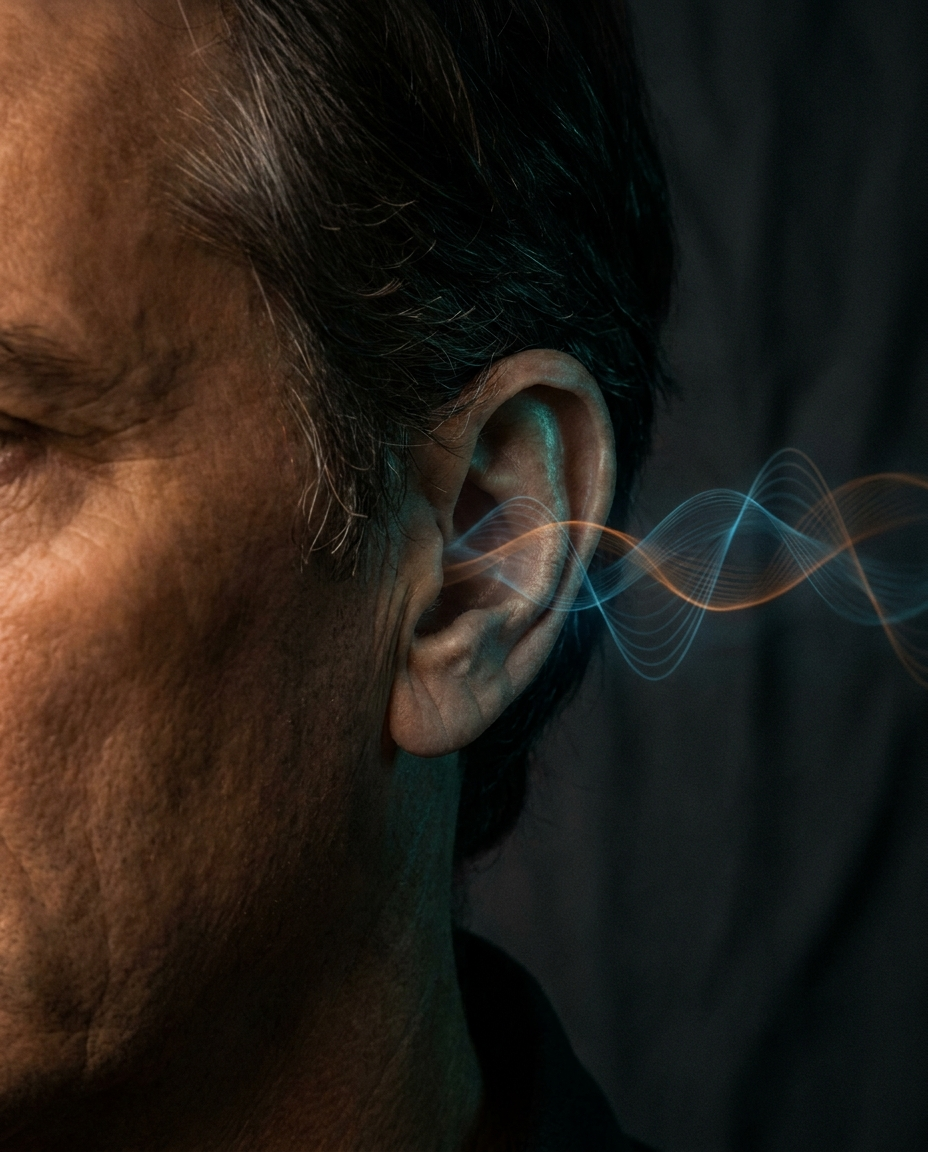
You probably had your eyes checked this year. You almost certainly did not have your hearing checked. Nobody in their 40s does, and that's a problem. Hearing loss is now the single largest modifiable risk factor for dementia, ahead of smoking, hypertension, and physical inactivity. The 2024 Lancet Commission on dementia prevention allocated 7% of the total population-attributable fraction to hearing loss alone (Livingston et al., 2024). That number is larger than any other individual factor on the list.
The connection isn't obvious at first. Hearing feels like a sensory issue. Cognitive decline feels like a brain issue. But the mechanism linking them is more direct than most people realize, and it starts decades before either problem becomes clinically visible. By the time you're saying "what?" more often at dinner, your brain has already been compensating for years, pulling resources away from memory and executive function to decode degraded sound signals.
Key Takeaways
- Hearing loss is the #1 modifiable risk factor for dementia, contributing more population-level risk than smoking or inactivity.
- Even mild hearing loss (25 dB) doubles the risk of cognitive decline over 12 years.
- Treating hearing loss with hearing aids slowed cognitive decline by 48% in at-risk populations in the largest randomized trial to date.
- A baseline audiogram in your 40s gives you a reference point most people never establish.
What Hearing Loss and Cognitive Decline Actually Mean Together
Hearing loss cognitive decline describes the well-documented relationship between reduced auditory input and accelerated deterioration in memory, processing speed, and executive function. Most people think hearing loss means not being able to hear. In practice, it means your brain works harder to hear, and that extra effort comes at a cost.
Think of your brain's processing power like bandwidth. When your auditory cortex receives a clean signal, it processes speech effortlessly, leaving plenty of capacity for comprehension, memory encoding, and forming a response. When the signal degrades, even slightly, your brain reallocates resources from higher-order functions to basic sound decoding. You hear the words but miss the meaning. Over years, this cognitive load reshuffling appears to accelerate structural brain changes that look a lot like early neurodegeneration.
The Screening Gap Nobody Talks About
Here is the uncomfortable fact: vision screening is a cultural norm after 40. Hearing screening is not. The average person waits 7 to 10 years after first noticing hearing difficulty before seeking evaluation (Davis et al., 2007). During that gap, the brain adapts in ways that become harder to reverse.
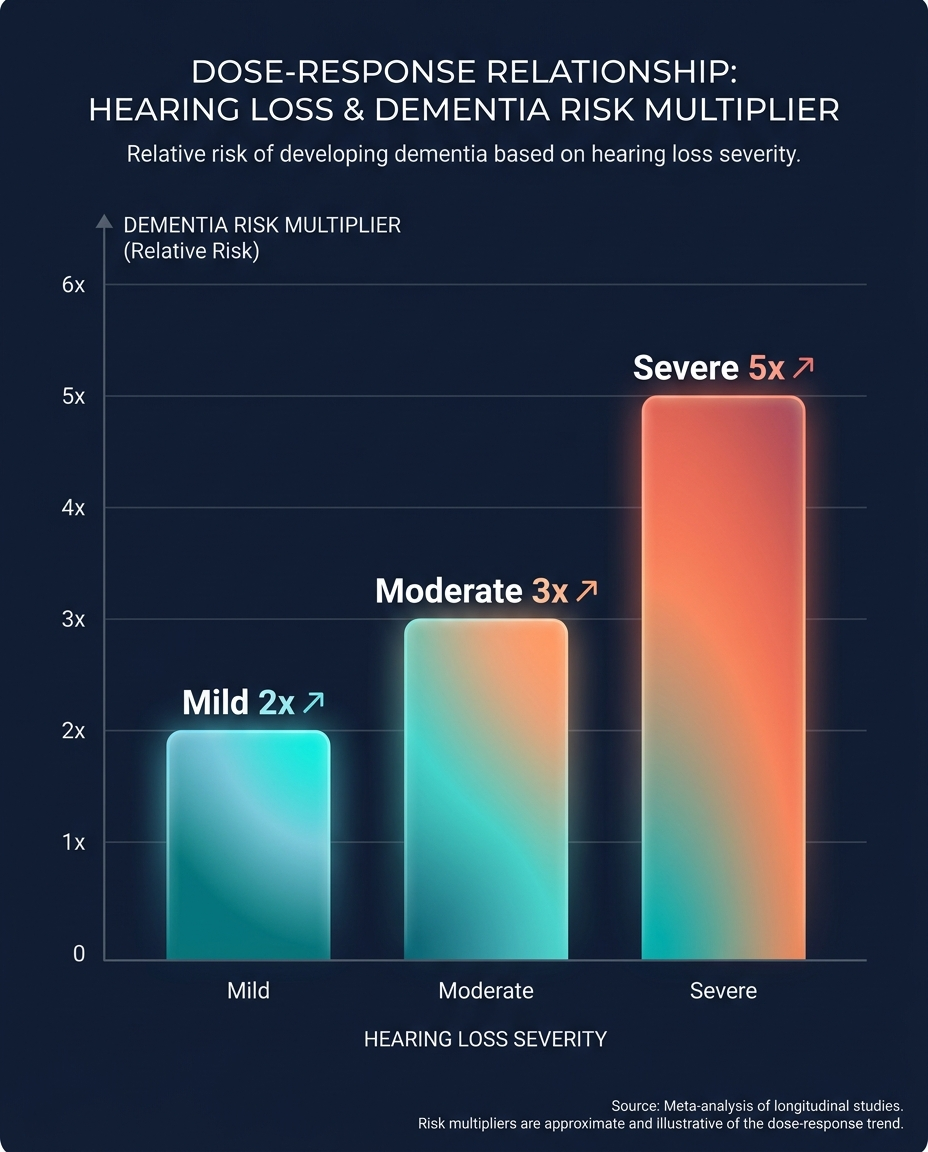
Frank Lin's research at Johns Hopkins tracked 639 adults for nearly 12 years and found that mild hearing loss doubled the risk of dementia, moderate loss tripled it, and severe loss increased it fivefold (Lin et al., 2011). The relationship held after adjusting for age, sex, cardiovascular risk, and education. This wasn't about people who were profoundly deaf. The risk started at 25 decibels of loss, a level most people would describe as "I hear fine, I just have trouble in noisy restaurants."
Worth knowing: the medical system has no infrastructure for catching hearing loss early in middle-aged adults. Your annual physical doesn't include an audiogram. Your doctor doesn't ask. And because hearing loss happens gradually, you adjust without realizing you're adjusting.

Confusing Volume for Clarity
The most common mistake is assuming hearing loss means things get quieter. It doesn't, at least not at first. What degrades first is clarity, specifically the ability to separate speech from background noise and to distinguish similar-sounding consonants. You turn up the TV not because it's too quiet but because the dialogue sounds muddy.
This matters for the cognitive decline connection because it's the clarity loss, not the volume loss, that drives the compensatory brain changes. Your auditory cortex works overtime to reconstruct degraded signals, and that effort is measurable on functional MRI. Peelle and colleagues showed that even mild hearing loss correlated with reduced gray matter volume in auditory cortex and adjacent temporal regions involved in speech comprehension and memory (Peelle et al., 2011). The brain areas doing double duty were physically shrinking.
There's a social dimension too. People with untreated hearing loss withdraw from conversations, skip social gatherings, and reduce engagement with complex auditory environments. Social isolation is itself an independent risk factor for cognitive decline. The Lancet Commission lists it separately, meaning hearing loss may drive dementia risk through at least two distinct pathways simultaneously: the direct cognitive load effect and the indirect social withdrawal effect.
Numbers Worth Tracking
| Signal | Standard "Normal" | Optimal Target |
|---|---|---|
| Pure tone average (PTA) | Under 25 dB | Under 20 dB |
| Speech-in-noise score | Varies by test | Above 85% correct |
| Word recognition score | Above 88% | Above 92% |
| Frequency range tested | 250 to 8000 Hz | No drop above 40 dB at any frequency |
The pattern matters more than any single number. A PTA of 22 dB with poor speech-in-noise scores tells a different story than a PTA of 22 dB with excellent speech discrimination. Get a full audiogram, not just a screening tone test.
What to Do About It
-
Get a baseline audiogram this year. An audiologist appointment takes 30 minutes. The test is painless and covered by most insurance plans. You need a baseline in your 40s so you can track change over time, the same logic behind baseline bloodwork. Without a starting point, you can't measure decline.
-
Retest every 2 to 3 years after 40. Hearing loss progresses at roughly 1 dB per year on average in this age group. Annual testing is unnecessary, but waiting a decade is too long. Set a calendar reminder.
-
If you have mild loss, treat it now. The ACHIEVE trial, the largest randomized controlled trial of hearing intervention and cognitive outcomes, found that hearing aids slowed cognitive decline by 48% over 3 years in adults at elevated dementia risk (Lin et al., 2023, n=977). That effect size is larger than any pharmaceutical intervention for cognitive decline currently available. Most people skip this. They shouldn't.
-
Protect the hearing you have. Noise exposure is cumulative and irreversible. Use earplugs at concerts and sporting events. Keep earbuds below 60% volume. Occupational noise above 85 dB damages cochlear hair cells permanently, and those cells do not regenerate.
-
Track cognitive baselines alongside auditory ones. Processing speed, working memory, and executive function are the domains most affected by hearing loss. Tracking both together reveals connections that a single metric would miss entirely.
This is the kind of cross-system tracking Rewind is built for. We monitor cognitive performance markers alongside sensory and recovery data so you can see how changes in one system ripple through others, before they become clinical problems.
Get Your Hearing Checked This Month
If you haven't had an audiogram since your 20s, or ever, this is the highest-leverage screening test you're not getting. Start with Rewind to track how auditory health connects to your broader cognitive and biological age picture.
Does hearing loss actually cause dementia?
The causal pathway isn't fully proven, but the association is strong and dose-dependent. Three leading theories explain the link: cognitive load (the brain diverts resources from memory to hearing), social isolation (hearing loss reduces engagement), and shared neuropathology (vascular damage affecting both systems). The ACHIEVE trial showed treating hearing loss slows cognitive decline, which supports a causal or contributory role.
At what age should I get my hearing tested?
A baseline audiogram in your 40s is reasonable for anyone. Earlier if you've had significant noise exposure from concerts, firearms, power tools, or occupational settings. After the baseline, retest every 2 to 3 years.
Do hearing aids prevent dementia?
"Prevent" is too strong a claim. The ACHIEVE trial showed a 48% reduction in cognitive decline among at-risk adults who used hearing aids over 3 years. That's the strongest intervention effect measured for any modifiable dementia risk factor. But the trial was 3 years, not 30. Longer data is still accumulating.
I hear fine in quiet rooms. Could I still have hearing loss?
Yes. Early hearing loss typically affects high-frequency sounds and speech-in-noise discrimination first. You'll hear fine one-on-one and struggle in a crowded restaurant. A full audiogram with speech-in-noise testing catches this pattern that a simple screening misses.
Rewind Insight: Hearing, cognition, and recovery are not separate systems. They're interconnected signals that tell a single story about how your body and brain are aging. Tracking them together is how you catch problems years before they become diagnoses.
Your brain has been quietly compensating for sensory decline you may not even notice yet. The fix starts with a 30-minute test that most people never schedule.
An audiogram in your 40s is one of the cheapest, highest-leverage health investments you can make.
Join Rewind and start building the complete picture of how your body is aging, not just the metrics everyone already tracks.
References
Davis, A., Smith, P., Ferguson, M., Stephens, D., & Gianopoulos, I. (2007). Acceptability, benefit and costs of early screening for hearing disability: A study of potential screening tests and models. Health Technology Assessment, 11(42), 1-294. https://doi.org/10.3310/hta11420
Lin, F. R., Metter, E. J., O'Brien, R. J., Resnick, S. M., Zonderman, A. B., & Ferrucci, L. (2011). Hearing loss and incident dementia. Archives of Neurology, 68(2), 214-220. https://doi.org/10.1001/archneurol.2010.362
Lin, F. R., Pike, J. R., Albert, M. S., Arnold, M., Burgard, S., Chisolm, T., ... & Deal, J. A. (2023). Hearing intervention versus health education control to reduce cognitive decline in older adults with hearing loss in the USA (ACHIEVE): A multicentre, randomised controlled trial. The Lancet, 402(10404), 786-797. https://doi.org/10.1016/S0140-6736(23)01406-X
Livingston, G., Huntley, J., Liu, K. Y., Costafreda, S. G., Selbaek, G., Alladi, S., ... & Mukadam, N. (2024). Dementia prevention, intervention, and care: 2024 report of the Lancet standing Commission. The Lancet, 404(10452), 572-628. https://doi.org/10.1016/S0140-6736(24)01296-0
Peelle, J. E., Troiani, V., Grossman, M., & Wingfield, A. (2011). Hearing loss in older adults affects neural systems supporting speech comprehension. Journal of Neuroscience, 31(35), 12638-12643. https://doi.org/10.1523/JNEUROSCI.2559-11.2011


Member discussion