
Eccentric Training After 40: Why Slowing Down the Rep Builds More Muscle

You spend 2 seconds lifting the dumbbell and half a second letting it drop. That ratio is backwards. The lowering phase of every rep, the part most people rush through, generates more force per muscle fiber than the lift itself. For anyone over 40 watching their strength plateau despite consistent gym time, this is the variable worth fixing. A 2024 randomized controlled trial found that older adults doing eccentric training just once a week gained 9 to 18% in muscle thickness across 12 weeks (Baxter et al., 2024, n=36). One session per week. The catch is that almost nobody trains this way on purpose.
Eccentric training is the science of loading the lengthening phase of a muscle contraction, and it is the most underused tool for building and keeping muscle past 40.
Key Takeaways
- Eccentric training produces greater muscle and strength gains per rep than traditional lifting, with lower cardiovascular strain.
- One eccentric session per week matched the results of two sessions in adults over 65 (Baxter et al., 2024).
- Slowing the lowering phase to 3 to 5 seconds per rep is the simplest way to start.
- Eccentric loading triggers muscle protein synthesis pathways that weaken with age, making it more important, not less.

What Eccentric Training Actually Is
Every rep has two halves. The concentric phase is the lift: curling the weight up, pressing it overhead, standing up from a squat. The eccentric phase is the controlled lower: letting the weight back down, descending into the squat, returning to the start. Think of it as the braking system in your muscles. Most people treat the eccentric like an afterthought. The weight goes up with effort and comes down with gravity.
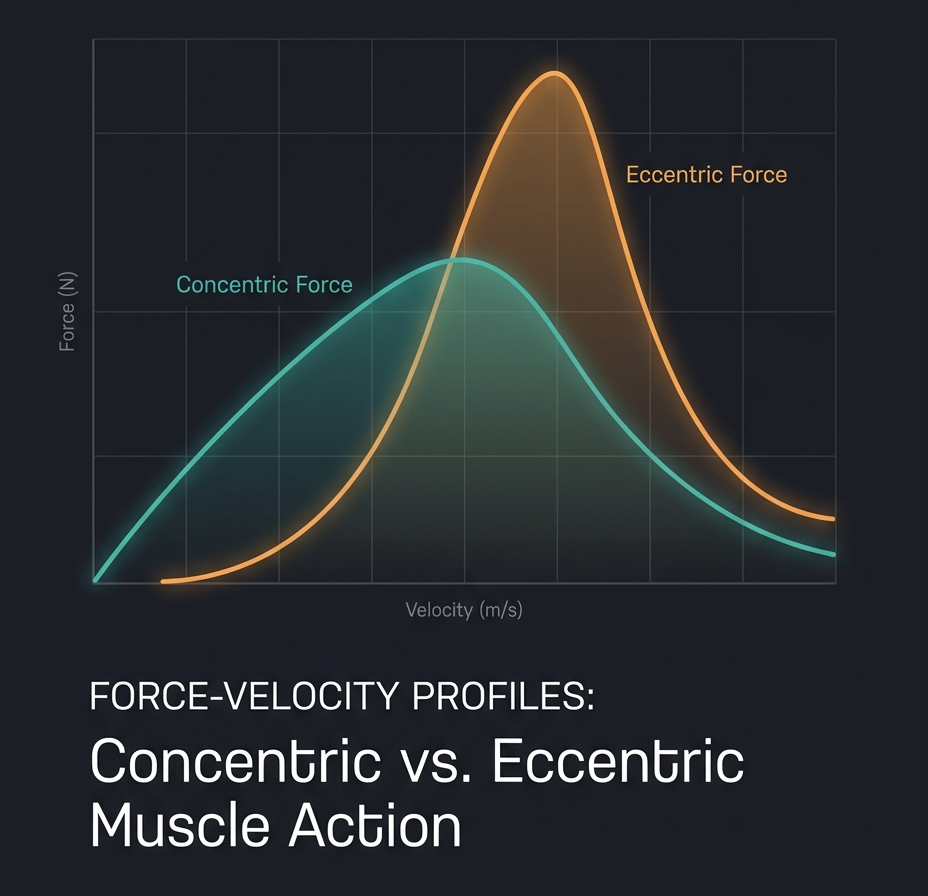
In practice, this means you are skipping the half of the rep where your muscles can handle the most load. Your muscles can resist roughly 20 to 50% more force during the eccentric phase than they can produce during the concentric phase (Cvečka et al., 2023). That gap is not a curiosity. It is the reason eccentric training works differently from everything else in the gym.
Most people think "eccentric" means some exotic training protocol. It does not. You already do eccentric contractions every time you walk downstairs, lower a grocery bag, or sit into a chair. The question is whether you are loading them enough to drive adaptation.
Why Your Default Training Approach Leaves Gains on the Table
The standard gym session for someone over 40 looks like this: pick a weight you can lift for 10 to 12 reps, move it up and down at a comfortable pace, rest, repeat. The concentric gets your attention. The eccentric gets neglected.
This matters because of what happens inside the muscle fiber during each phase. Eccentric contractions recruit more type II (fast twitch) muscle fibers per unit of force than concentric contractions. Type II fibers are the ones you lose fastest after 40, roughly 1 to 2% per year. They are responsible for power, speed, and the kind of strength that keeps you from falling. A training approach that underloads the eccentric is a training approach that underloads the fibers you most need to keep.
There is a metabolic angle too. Eccentric work produces high mechanical tension with relatively low energy expenditure and lower heart rate demand than equivalent concentric work. For anyone managing joint issues, blood pressure considerations, or simple fatigue from a full work schedule, this is not a small detail. You get more mechanical stimulus per unit of cardiovascular cost.
The Research on What Eccentric Training Does After 40
The most practical study on this came out of Edith Cowan University in 2024. Baxter and colleagues split 36 older adults (average age 69.4 years) into two groups: one trained eccentrically once a week, the other twice a week. Both groups performed submaximal eccentric leg exercises over 12 weeks.
The results surprised the researchers. Both groups saw nearly identical improvements: 13% increases in power, 17 to 36% gains in isometric strength, 40 to 50% improvements in eccentric strength, and 9 to 18% increases in vastus lateralis muscle thickness (Baxter et al., 2024). One session produced the same adaptations as two.
This efficiency matters. The blunted response to exercise that comes with aging is well documented. Fry and colleagues showed in 2011 that after identical resistance exercise bouts, younger adults (average age 27) activated mTORC1 signaling and increased muscle protein synthesis within hours, while older adults (average age 70) showed no significant activation at all (Fry et al., 2011, n=32). The machinery that builds muscle after a workout gets sluggish with age. Eccentric loading appears to partially compensate by creating a stronger mechanical stimulus that can still push through that blunted signaling.
A 2021 review in Frontiers in Physiology proposed that minimal dose eccentric resistance training could serve as a frontline strategy against sarcopenia, specifically because it achieves high muscle tension with low metabolic demand and minimal perceived exertion (Fang & Tseng, 2021). The authors argued that this makes it not just effective but sustainable, which is the variable that actually determines whether a training program works over years rather than weeks.

The Tempo Trap Most Lifters Fall Into
The single most common mistake is treating tempo as an afterthought. Watch most people in any gym and you will see a 1 second concentric followed by an uncontrolled drop. They are doing half a rep and calling it a full one.
The fix is embarrassingly simple, but it requires checking your ego. Slow the eccentric to 3 to 5 seconds. This means the weight you use will drop, often by 20 to 30%. A 40 pound dumbbell curl becomes a 30 pound dumbbell curl with a 4 second lower. The load on the bar looks less impressive. The load on your muscles is higher. Most people will feel more soreness from the first session of deliberate eccentric work than from months of their regular routine. That soreness fades as the muscle adapts, usually within 2 to 3 sessions.
Numbers Worth Tracking This Week
| Signal | Standard Benchmark | Optimal Target |
|---|---|---|
| Eccentric tempo per rep | 1 to 2 seconds (typical) | 3 to 5 seconds |
| Weekly eccentric sessions | 0 dedicated sessions | 1 to 2 sessions |
| Type II fiber recruitment | Low (fast reps) | High (slow eccentrics) |
| Perceived exertion (RPE) | 7 to 8 (traditional) | 5 to 6 (eccentric focus) |
| Muscle soreness (DOMS) days 1 to 2 | Minimal | Moderate (first 2 to 3 weeks) |
The pattern here is counterintuitive. Lower perceived effort during the session, higher mechanical stimulus to the muscle. When your RPE feels lower but your muscles are more sore the next day, the eccentric loading is working.
How to Start Eccentric Training This Week
-
Pick 3 compound movements and add a 4 second eccentric. Squat, bench press, and row are the simplest starting points. Lower the weight for 4 full seconds on every rep. Keep the concentric normal. Reduce load by 20 to 30% from your usual weight to maintain control. This single change shifts your entire session toward eccentric emphasis without learning new exercises.
-
Add one dedicated eccentric set per exercise at the end of your workout. After your regular sets, load the bar 10 to 20% heavier than your concentric max. Use a spotter or safety pins to handle the concentric (or skip it entirely with a rack setup). Perform 3 to 5 slow eccentrics only. This is where the real overload happens.
-
Train eccentrically once per week for the first month. The Baxter et al. data shows once weekly is sufficient for measurable gains. Start conservative. Eccentric training creates more muscle damage than concentric work, and recovery takes longer, especially in your first month. Add a second session only after 4 weeks if recovery is solid.
-
Use eccentric training for the muscles that matter most after 40. Prioritize quadriceps (squat eccentrics), hamstrings (Romanian deadlift eccentrics), and shoulder external rotators (slow cable rotations). These are the muscle groups most vulnerable to age related decline and most responsive to eccentric loading.
This is exactly the kind of training variable Rewind tracks. We monitor your recovery markers, HRV, and training load so you can push eccentric intensity without guessing whether your body has adapted or is still catching up.
Start Training the Lowering Phase
If your training is not deliberately loading the eccentric, you are leaving your most powerful muscle building stimulus untouched. One focused session per week is enough to start.
Start tracking your training recovery with Rewind.
FAQ
What is eccentric training in simple terms?
Eccentric training means focusing on the lowering or lengthening phase of an exercise. When you slowly lower a dumbbell during a bicep curl or descend into a squat, your muscles are contracting eccentrically. You emphasize this phase by slowing it down to 3 to 5 seconds per rep.
Is eccentric training safe for people over 50?
Yes. Research on adults averaging 69 years old showed low to zero injury rates from eccentric protocols (Baxter et al., 2024). The cardiovascular demand is lower than traditional lifting, making it suitable for people managing blood pressure or joint issues. Start with lighter loads and progress gradually.
How sore will I get from eccentric training?
Expect moderate delayed onset muscle soreness (DOMS) for the first 2 to 3 sessions, peaking 24 to 48 hours after your workout. This is normal and reflects the novel stimulus. The soreness diminishes rapidly as your muscles adapt, a phenomenon called the repeated bout effect.
Can I do eccentric training at home without a gym?
Absolutely. Slow bodyweight squats (4 second lower), slow push up negatives, and step downs from a stair (lower on one leg for 4 seconds) are effective eccentric exercises. No equipment required. The key is the tempo, not the load.
How long before I see results from eccentric training?
The Baxter et al. 2024 study measured significant strength and muscle thickness improvements after 12 weeks of once weekly eccentric training. Most people notice improved control and reduced soreness within 2 to 3 weeks. Measurable strength gains typically appear by week 6.
Eccentric training is not a new concept, but the dose required is far smaller than most people assume. One deliberate session per week, with controlled tempo on every rep, is enough to shift the trajectory of muscle loss after 40. The data is consistent on this point.
The hardest part of eccentric training is not the effort. It is the patience. Slowing down feels wrong when you have been taught that more reps and heavier loads are the answer. But after 40, the quality of each contraction matters more than the quantity. Your muscles already know how to lift. Teach them how to lower.
See how Rewind helps you train smarter as you age.
References
Baxter, B. A., Hogarth, L., Sherlock, R., Sheridan, C., Kay, A. D., & Sheridan, G. (2024). Effects of once- versus twice-weekly eccentric resistance training on muscular function and structure in older adults: A randomised controlled trial. Scientific Reports, 14, 10232. https://doi.org/10.1038/s41598-024-59788-9
Cvečka, J., Tirpáková, V., Sedliak, M., Kern, H., Mayr, W., & Hamar, D. (2023). Benefits of eccentric training with emphasis on demands of daily living activities and feasibility in older adults: A literature review. International Journal of Environmental Research and Public Health, 20(4), 3172. https://doi.org/10.3390/ijerph20043172
Fang, Y., & Tseng, W. C. (2021). Potential benefits of a minimal dose eccentric resistance training paradigm to combat sarcopenia and age-related muscle and physical function deficits in older adults. Frontiers in Physiology, 12, 790034. https://doi.org/10.3389/fphys.2021.790034
Fry, C. S., Drummond, M. J., Glynn, E. L., Dickinson, J. M., Gundermann, D. M., Timmerman, K. L., Walker, D. K., Dhanani, S., Volpi, E., & Rasmussen, B. B. (2011). Aging impairs contraction-induced human skeletal muscle mTORC1 signaling and protein synthesis. Skeletal Muscle, 1, 11. https://doi.org/10.1186/2044-5040-1-11


Member discussion